global institutions made a permanent commitment to preserve open research data
Source / detailsShare Data to
Advance
Research
Dataverse is a global community formed around open source software and protocols. More than 150 institutions run their own Dataverse installations; Harvard Dataverse is the founding installation.
scholarly citations connected to Harvard Dataverse datasets
Source / detailspublished datasets reported by the network’s repositories
Source / detailson Harvard Dataverse since 2020
Source / detailson Harvard Dataverse since 2020
Source / detailson Harvard Dataverse since 2020
Source / detailsFOUNDING PRINCIPLE
Data Branded as Yours
All credit goes to the data creator, author, and institution. That is the Dataverse’s founding principle, set out in King (2007), “An Introduction to the Dataverse Network as an Infrastructure for Data Sharing”.
Your Collection, Your Identity
Your logo, colours and web address, with the collection embedded on your own site.
See a live example →Yours to Use and Shape
Everyone builds it. You customize it. It is branded as yours.
How institutions put it to work →Governance You Control
Assign contributor and curator roles, set metadata requirements, manage access and terms of use, and publish citable datasets and new versions under your own rules.
What the software provides →THE FOUNDING REPOSITORY
Open to Harvard.
Open to Everyone.
Harvard Dataverse is where the project began and remains one of the largest repositories of open research data in the world: researchers from any institution and any discipline can deposit, and every dataset is cited and preserved. It is one repository among the 150+, run on the same software as all the others.
119,853published datasets
398,347scholarly citations to data deposited by Harvard researchers
3,126,731unique downloads by people since 2020
Source / detailsA GLOBAL COMMUNITY
Built, Run and Improved by the Dataverse Research Community.
Developers, data curators, librarians and researchers from the 150+ installations contribute code, documentation, translations and support. They meet every year at the Dataverse Community Meeting, talk monthly on community calls, and coordinate through the Global Dataverse Community Consortium (GDCC), the body through which installations share work on containers, documentation, large and sensitive data, and more.
The project is led from Harvard’s Institute for Quantitative Social Science, which built the first release in 2006 and still maintains the software with the community.
Who leads it →Installations Around the World
Full list of installations- Canadian research institutionsBorealis
- France · National research infrastructureRecherche Data Gouv
- Colombia · GovernmentMinistry of Cultures, Arts and Knowledge
- United States · Research laboratoryNASA Jet Propulsion Laboratory
- Norway · National repositoryDataverseNO
- United States · UniversityUniversity of North Carolina





How to Get Involved
Working Groups
Run by the Global Dataverse Community Consortium (GDCC), the body through which installations coordinate. Anyone may join a group; no membership or fee is required.
- Containerization
- Documentation
- Internationalization
- Large Data Support
- pyDataverse
- Sensitive Data
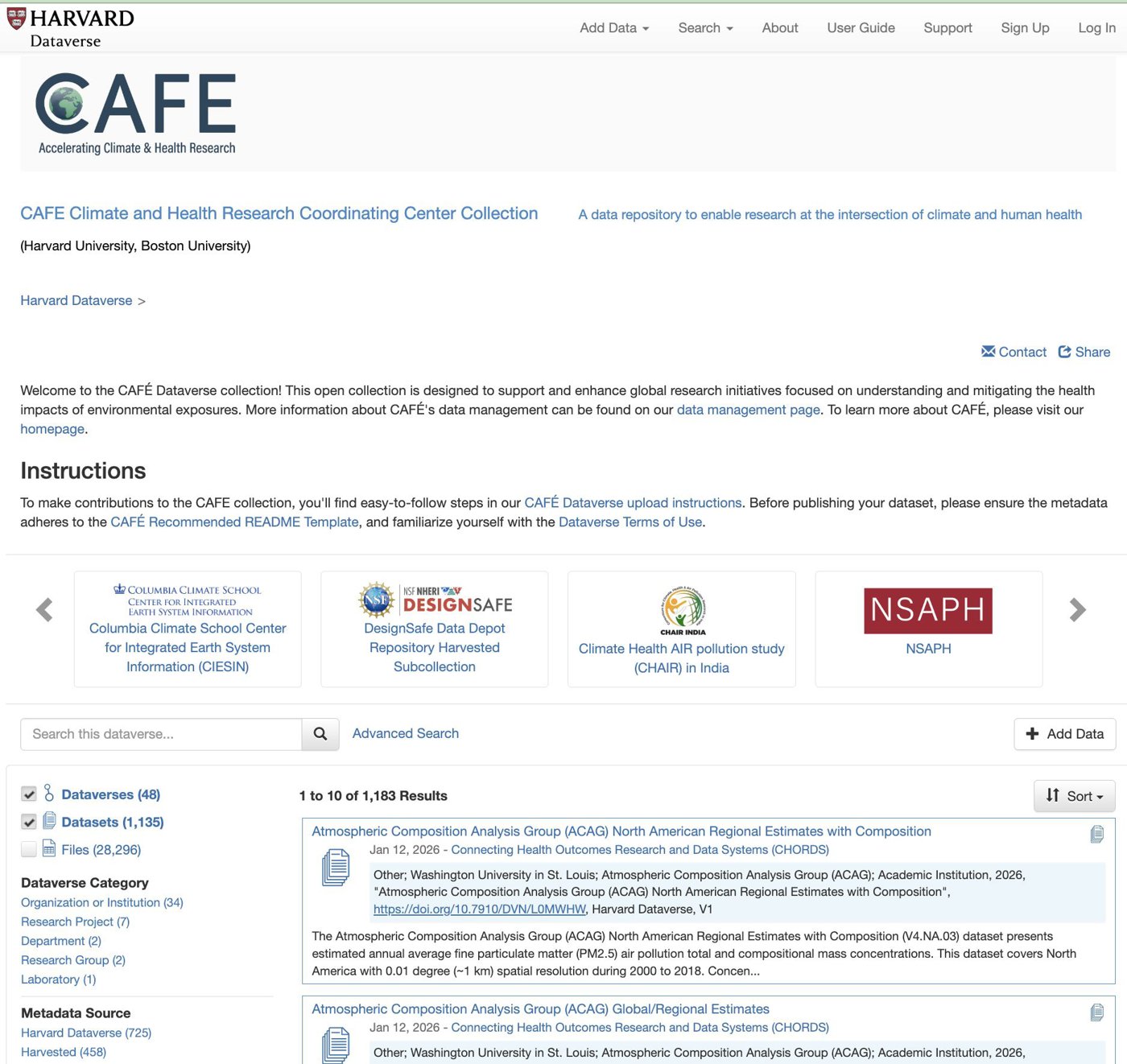 Research teams · Data sharing storyA Data-Sharing Community for Health and Extreme WeatherCAFE RCC, the NIH-funded Research Coordinating Center at Boston University and Harvard Chan, built a 48-collection data-sharing environment on Harvard Dataverse with the Dataverse team.CAFE collection
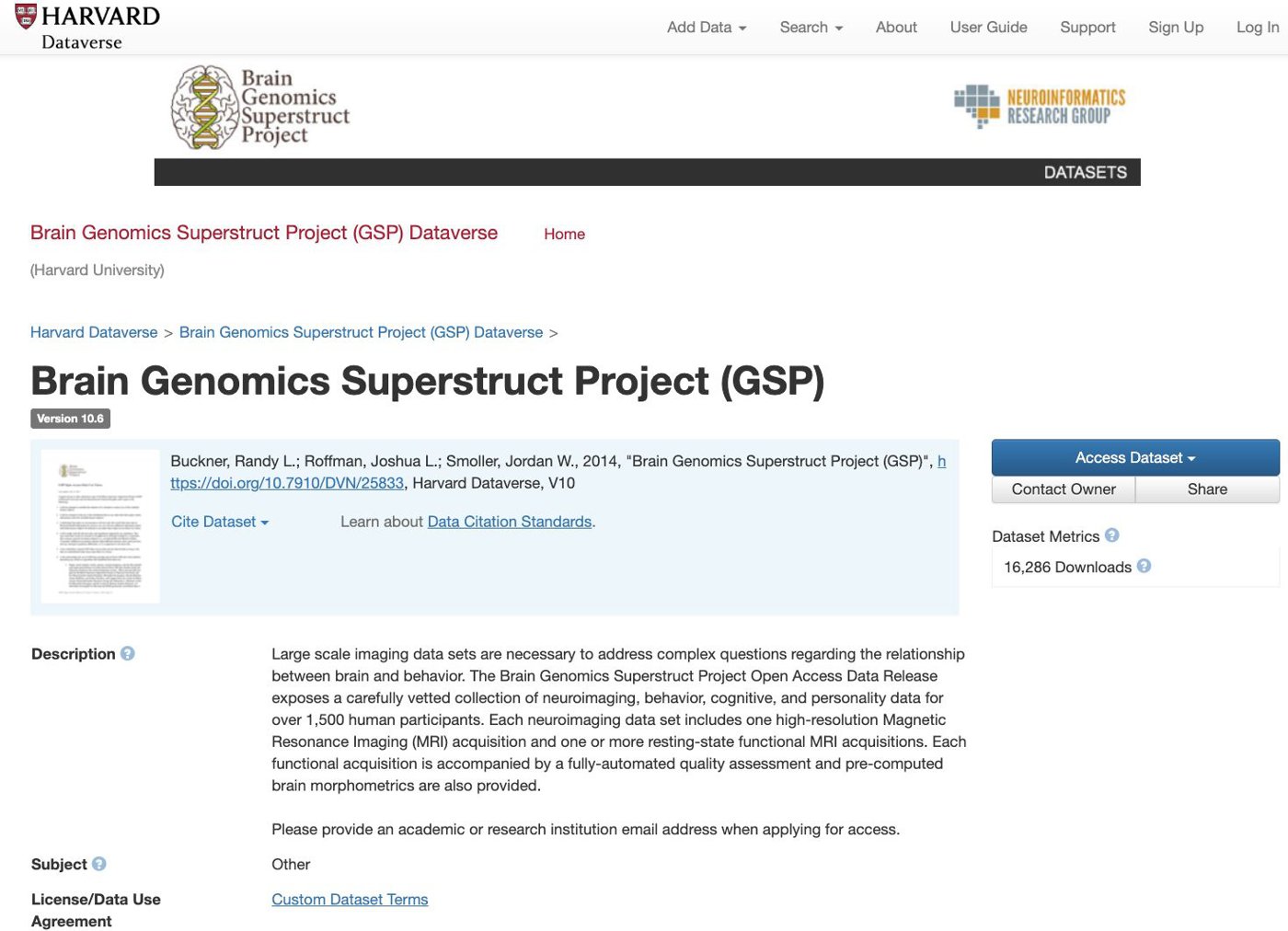 Researchers · Data sharing storySharing the Brain Genomics Superstruct ProjectNeuroimaging, behavioral, cognitive and personality data from more than 1,500 participants, released openly on Harvard Dataverse and reused in Nature Medicine and Journal of Neuroscience papers.GSP dataset
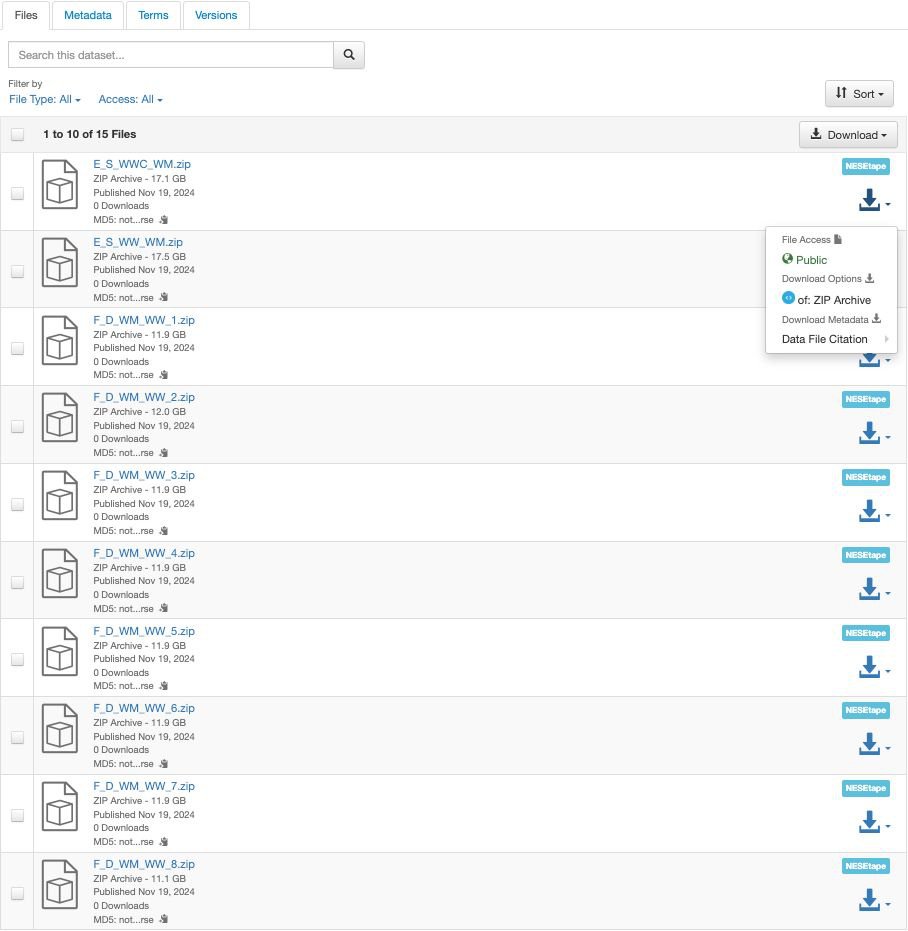 Researchers · Case studySharing Big DataHow DrivAerNet++, 16 terabytes of automotive simulation data from MIT and TUM, is stored on tape and downloaded through Globus from Harvard Dataverse.DrivAerNet++ dataset
 Researchers · Case studyMeeting an NIH Data Management and Sharing PlanAn NIH-funded researcher deposits project data so that it satisfies the data management and sharing plan and the conditions of the grant.HemOnc ontology dataset
 Researchers · Case studyFinding Data to ReuseA researcher searches a generalist repository to validate findings, reuse data and build on work within a discipline.Harvard Dataverse
 Institutions · Case studyHarvard Dataverse as an Institutional Data RepositoryAn institution gives its researchers a place to deposit and share outputs, reports on aggregate usage, and connects the repository to other systems through APIs.Harvard Dataverse
 Institutions · Case studyReporting on an Institution's DatasetsAn administrator tracks every dataset from the institution in Harvard Dataverse to confirm that researchers meet their data-sharing commitments.Harvard Dataverse
 Funders · Case studyTracking NIH-Funded DatasetsA funder finds the datasets it supported, reports on policy compliance and follows how the data is used.Harvard Dataverse
 Research teams · FeatureIndigenous Data With Local Contexts Labels and NoticesDataverse connects to the Local Contexts Hub, so a dataset page can display the Traditional Knowledge and Biocultural Labels and Notices that an Indigenous community has applied to its data.Talks: OR 2023, IASSIST 2023Local Contexts guide
 American Journal of Political ScienceJournal collection on Harvard DataverseView Data Collection
 American Political Science ReviewJournal collection on Harvard DataverseView Data Collection
 Political AnalysisJournal collection on Harvard DataverseView Data Collection
 The Quarterly Journal of EconomicsJournal collection on Harvard DataverseView Data Collection
 NeurIPSHarvard Dataverse is a preferred hosting platform for the Evaluations & Datasets track.Read Hosting Guidelines
 FrontiersAuthors publish supporting research data on Harvard Dataverse.View a Published Example
- The SoftwareArchitecture, APIs, metadata standards, storage and large-data options, authentication, deployment.
- Run DataverseStart a complete installation in a container in about five minutes, or try the hosted demo.
- ReleasesQuarterly releases since 2015, with notes and upgrade steps for each.
- RoadmapThe big-picture priorities for the year and the technical milestones behind them.
- GuidesUser, admin, installation, API and developer guides, the reference for every feature.
- Source CodeApache-licensed, developed in the open on GitHub; issues and pull requests welcome.
Integrations
Explore the Integrations Guide RSpace
 Google Data CommonsRoadmap collaboration
 Open Science Framework (OSF)
 GitHub
 Dropbox
 Open Journal Systems (OJS)
 Open Preprint Systems (OPS)
 Amnesia
 SampleDB
 REDCap
 GitLab
 iRODS
- Integrations DashboardIntegrations DashboardIn development
 Globus
 DataLad
 Open OnDemand
 Galaxy
 OpenScholar
 Data Explorer
- Compute ButtonCompute ButtonExperimental
 Binder
 Renku
 Avgidea Data Search
 JupyterHub
 Rclone
 Geodisy
 DataONE
 Archivematica
 RDA BagIt (BagPack) Archiving
Thanks to the Generous Support From
 Google
 firebrand.ai
 NSF
 NIH
 GREI
 GDCC
 Bertarelli Foundation
 Harvard FAS
 Alfred P. Sloan Foundation
 Helmsley Charitable Trust
 Harvard Data Science Initiative
 Office of the President and Provost, Harvard University
 Institute of Museum and Library Services
 Massachusetts Institute of Technology
 Office of Naval Research
 Regents of the University of Michigan
- RMDS Lab
- Social Science Research Council
 University of Pittsburgh
 US Department of State